
Second Brain Link — the context layer for personal AGI: turn the data exports you already own into a private, identity-resolved brain your agents can use on day one
The context layer for personal AGI
Destination reached
The whole road, in one connected brain.
Every source, person and chapter you drove past — resolved into one identity, linked, and ready for an agent to reason over. Opens in Obsidian and Claude Code. Runs 100% on your machine, with zero network calls in the core.
Free · open source (MIT) · your data never leaves your machine
Second Brain Studio
See how it all connects. Then just ask.
No setup, no plugins. Open your vault in a live workspace: explore how everything connects, read and edit notes, and ask an AI that reasons over the whole graph. It runs locally — your API keys and data never leave your machine. New: the graph renders as living tissue — and you can watch a question fire through it.
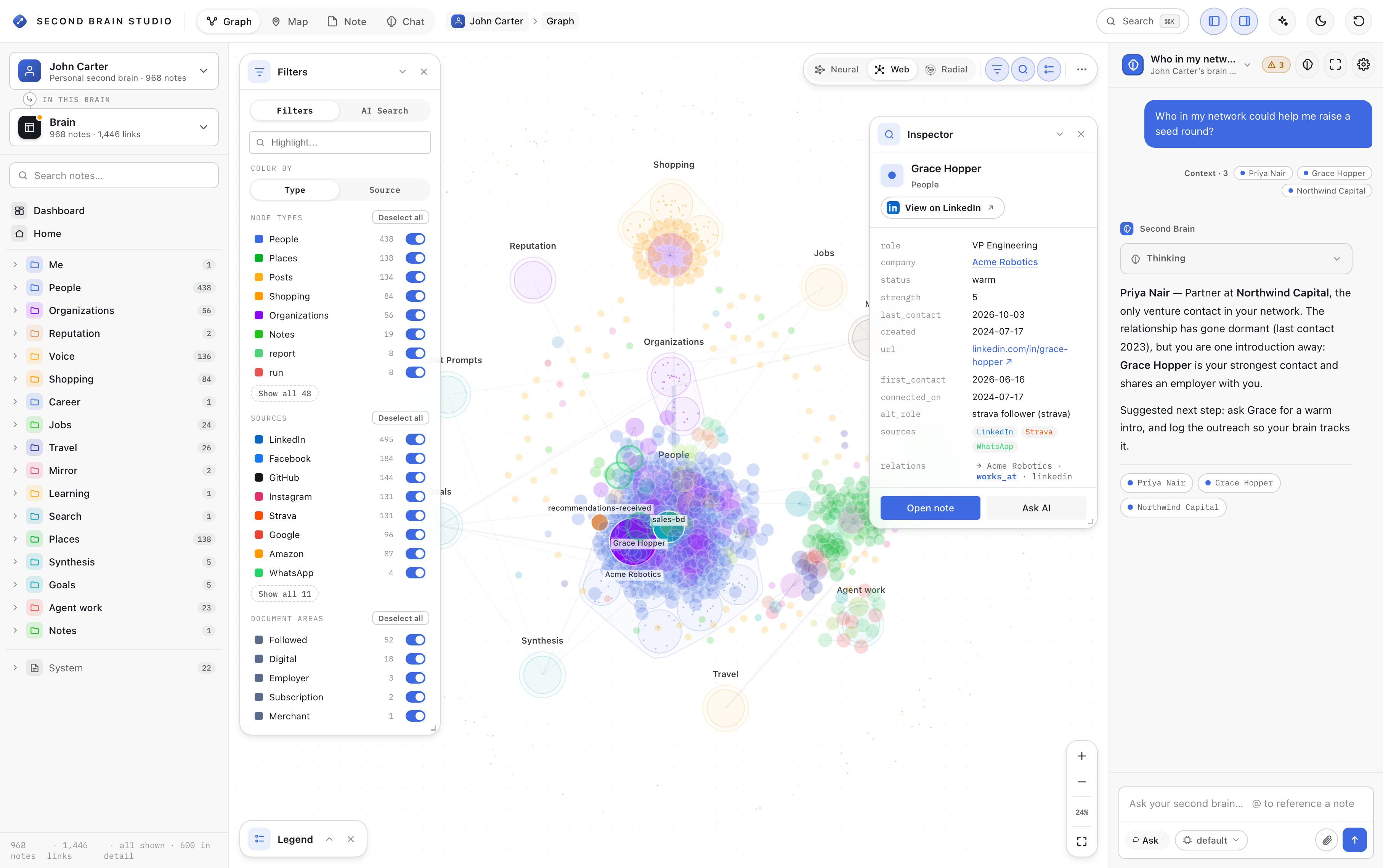
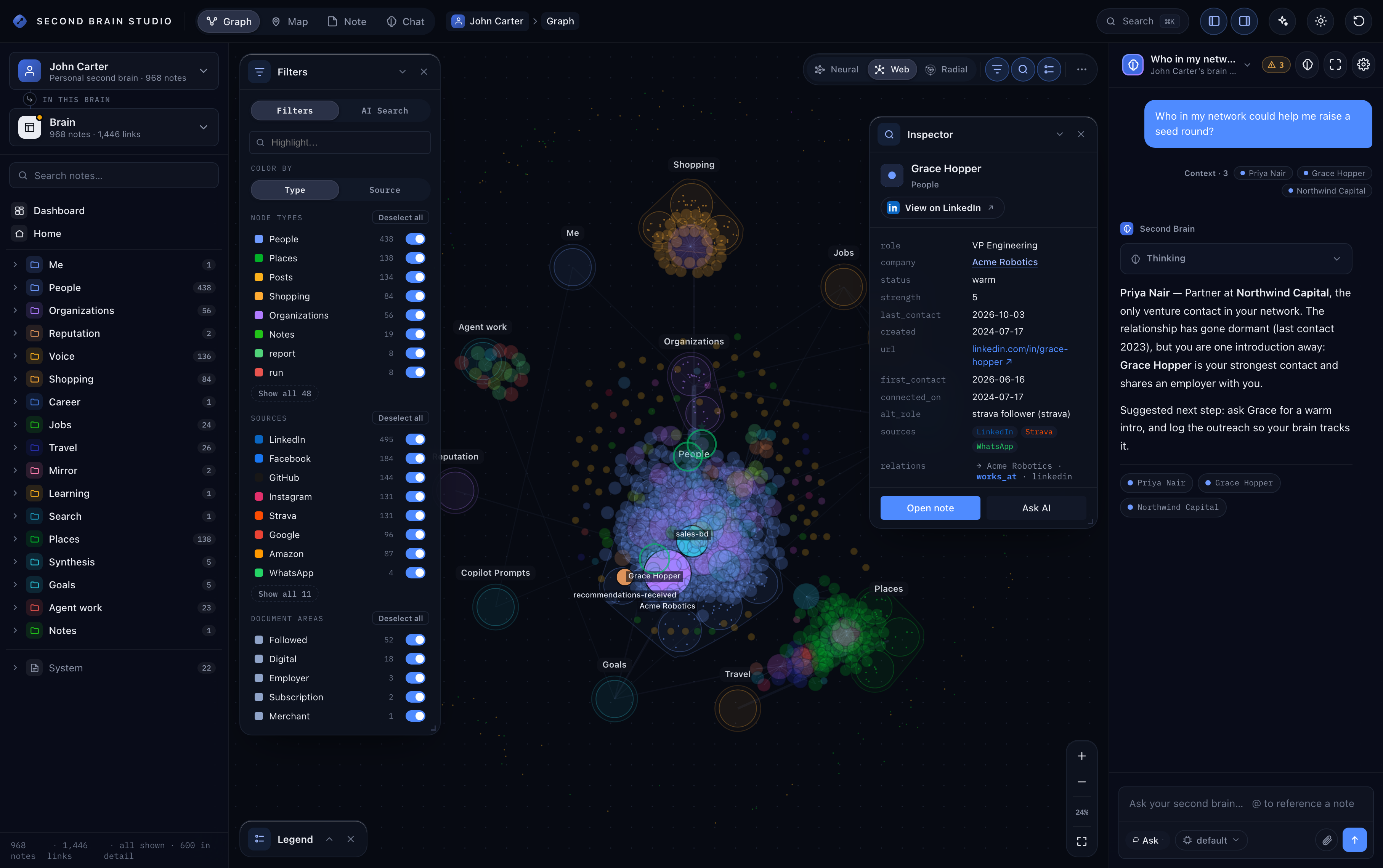
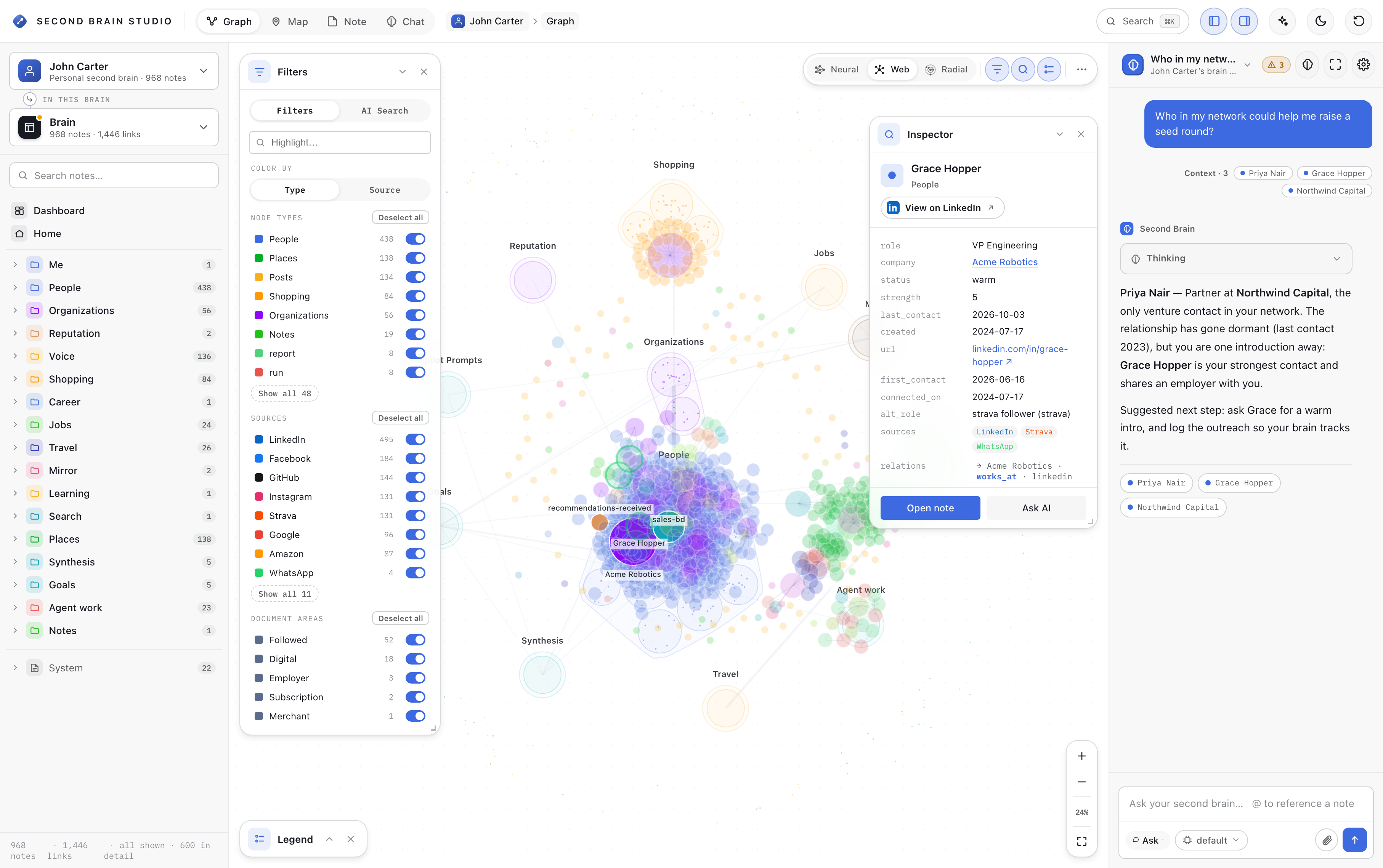
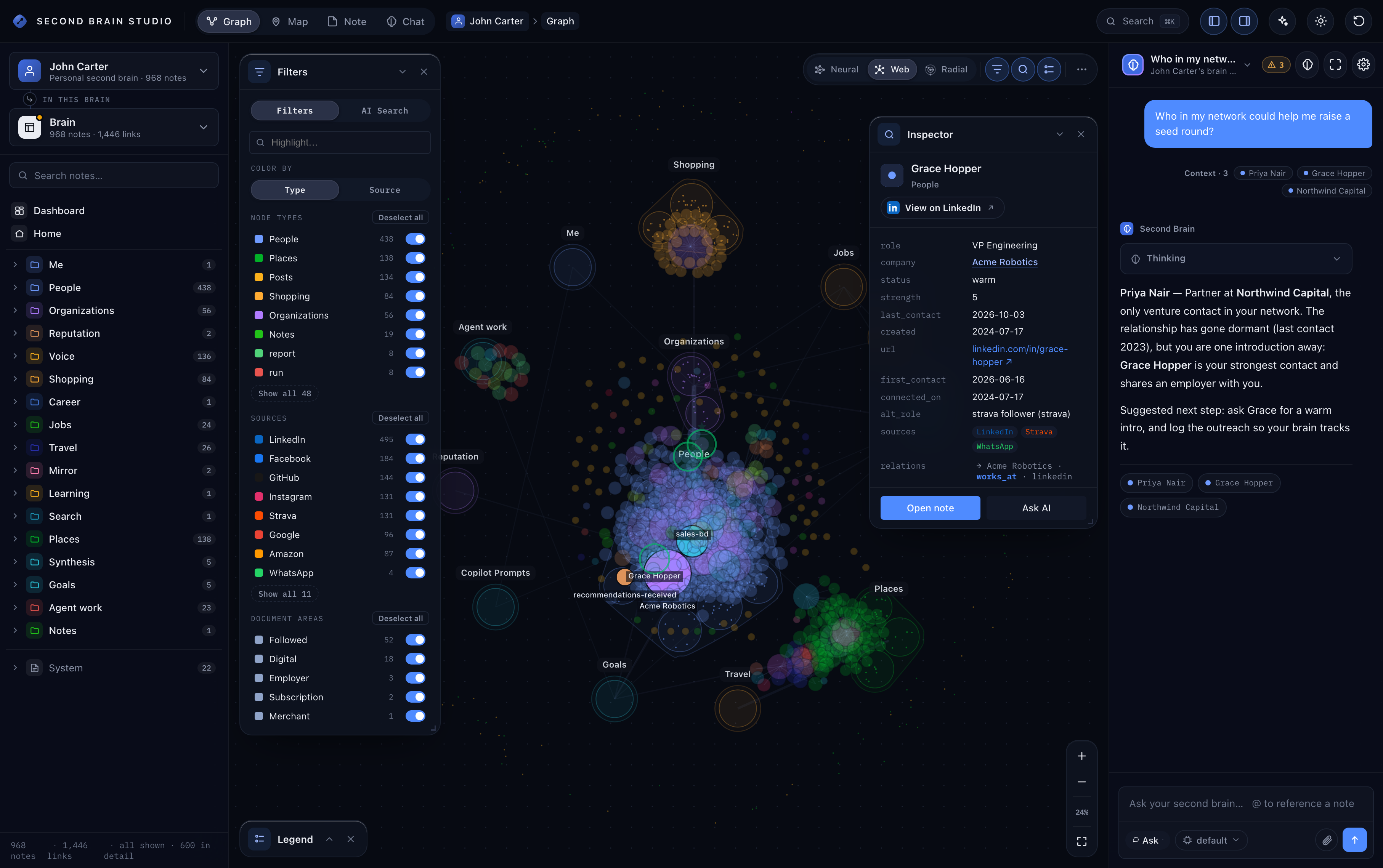
Interactive graph
A live, force-directed graph of every person, org, place and post. Filter by type or source, search, and click any node to open its note.
Talk to your brain
A built-in assistant — Claude, OpenAI, Gemini and more — that cites the notes it used. Bring your own key; calls go straight to the provider.
Read, edit & track
A full Markdown editor with live preview, wikilinks and backlinks, plus a computed dashboard of your network and clusters.
Graph ⇄ Map
newFlip the graph to a map: every geo-tagged place, person and organization, filtered by country and kind of place — your own Maps key, nothing uploaded.
Agents that act
newA third tab beside Vault and Sources: run the Jobs, Fundraising or Travel agent against your brain, watch its note update live, answer its gates with a click.
Attachments in place
PDFs and other files your exports carried open inside Studio, next to the notes that cite them — no round trip through another app.
Second Brain Mobile · the free on-ramp
Your brain, built on the phone. No account, no cloud.
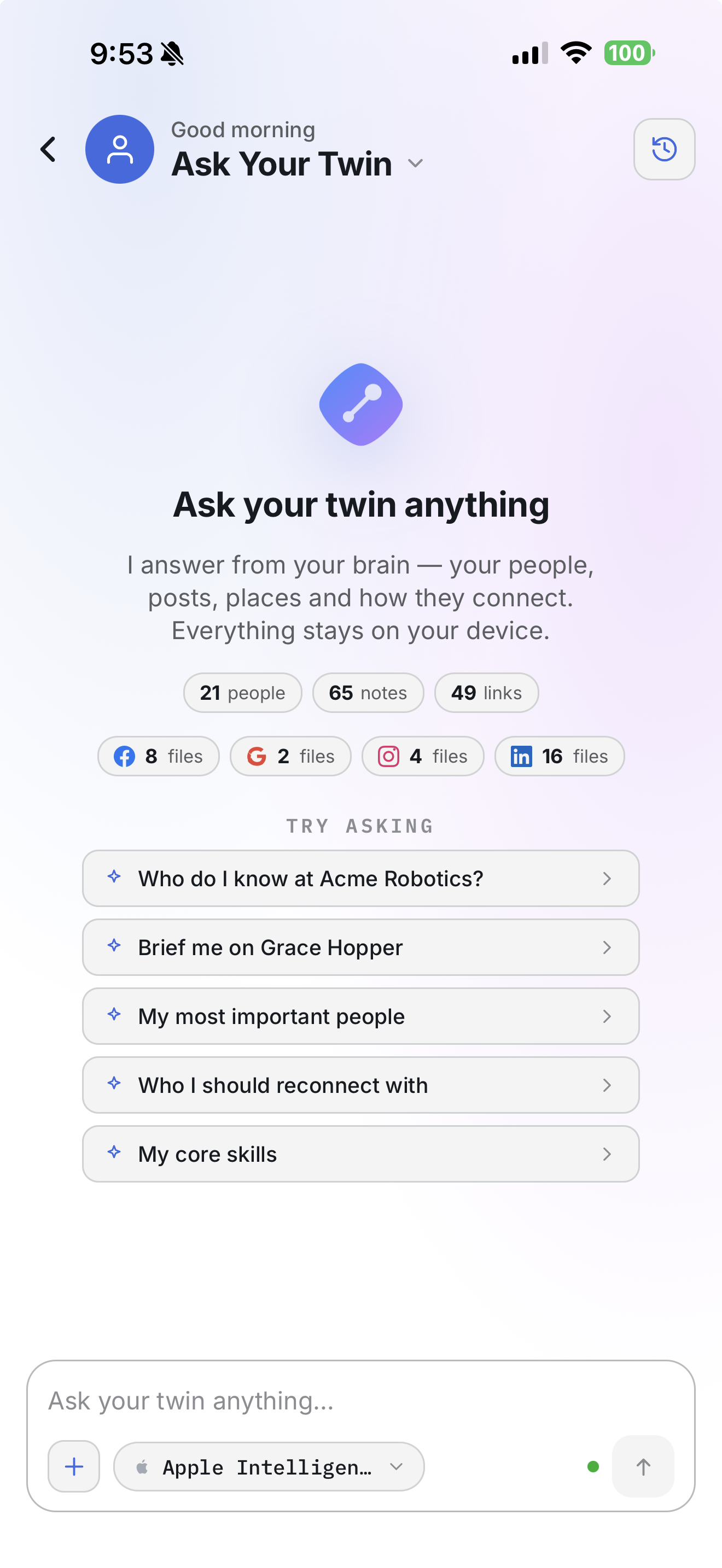
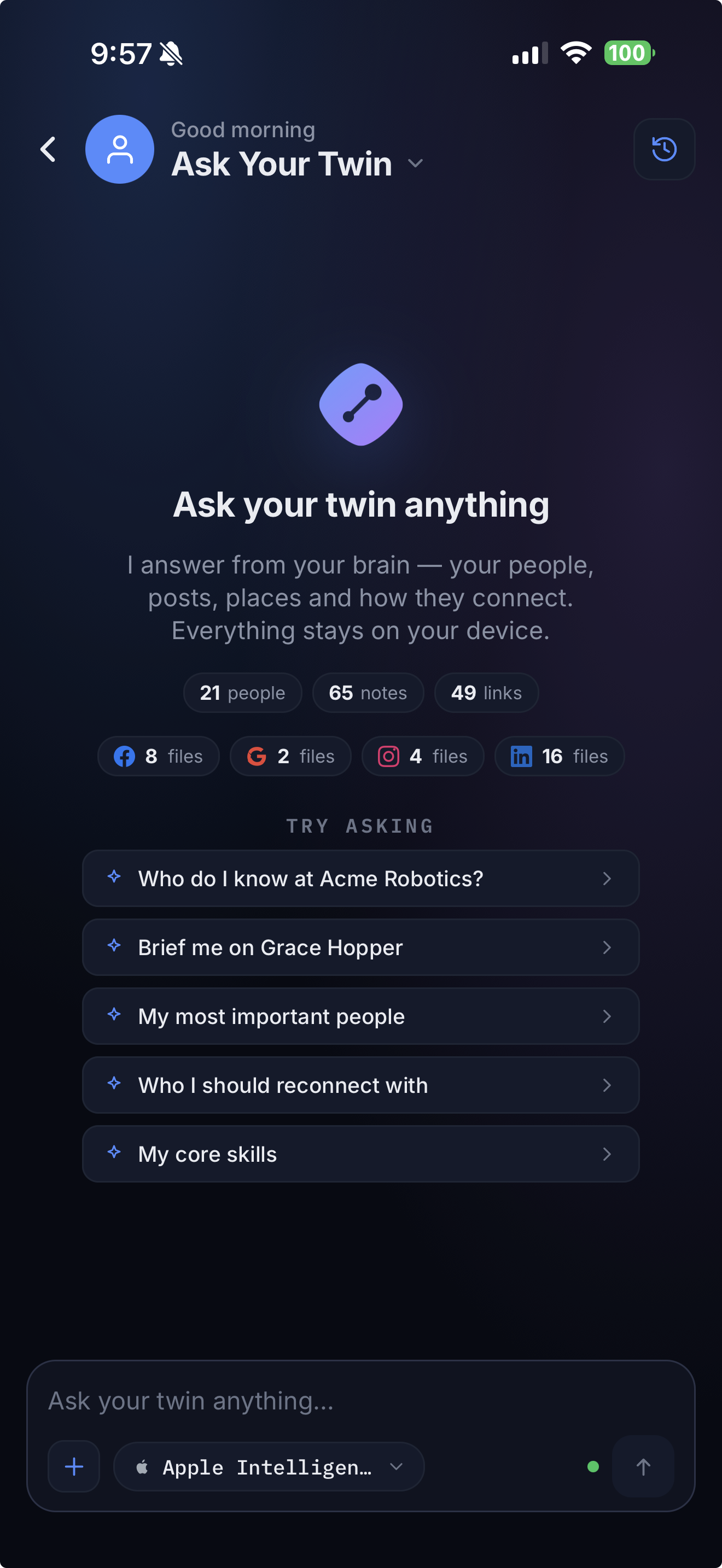
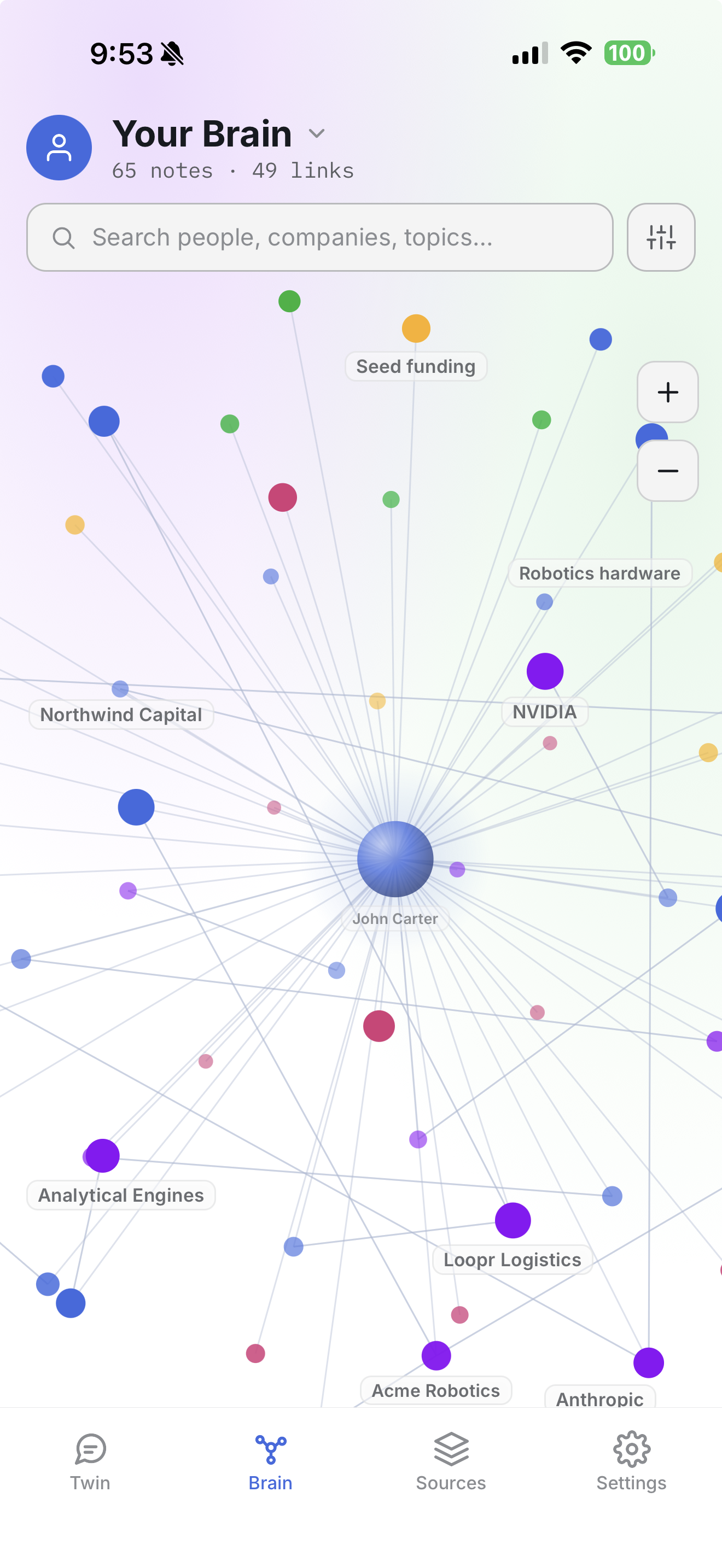
A native mobile app that unpacks your exports and builds the brain on-device: no account, no cloud, nothing uploaded. Explore the knowledge graph and talk to your twin — with Apple Intelligence running on-device on iPhone, or your own AI keys stored in the phone's keychain.
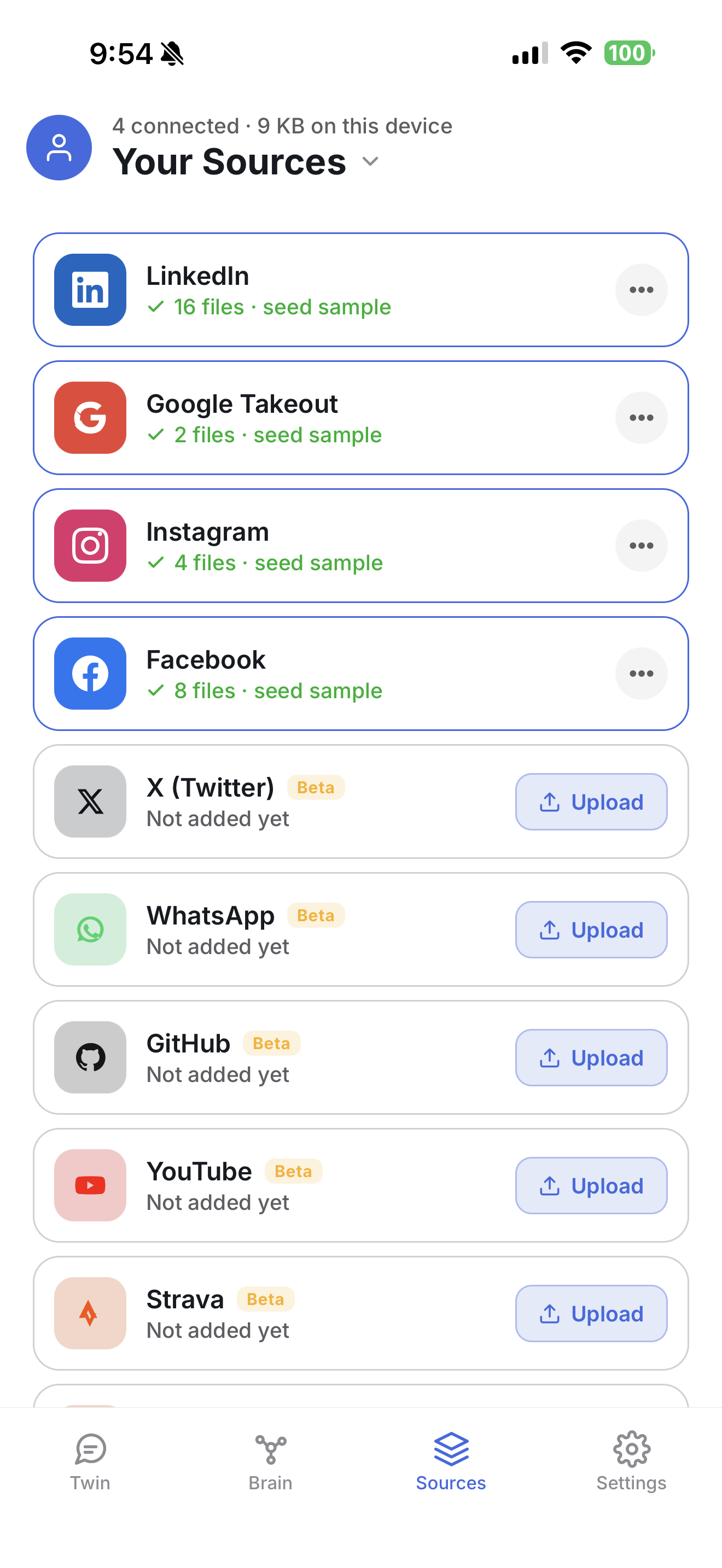
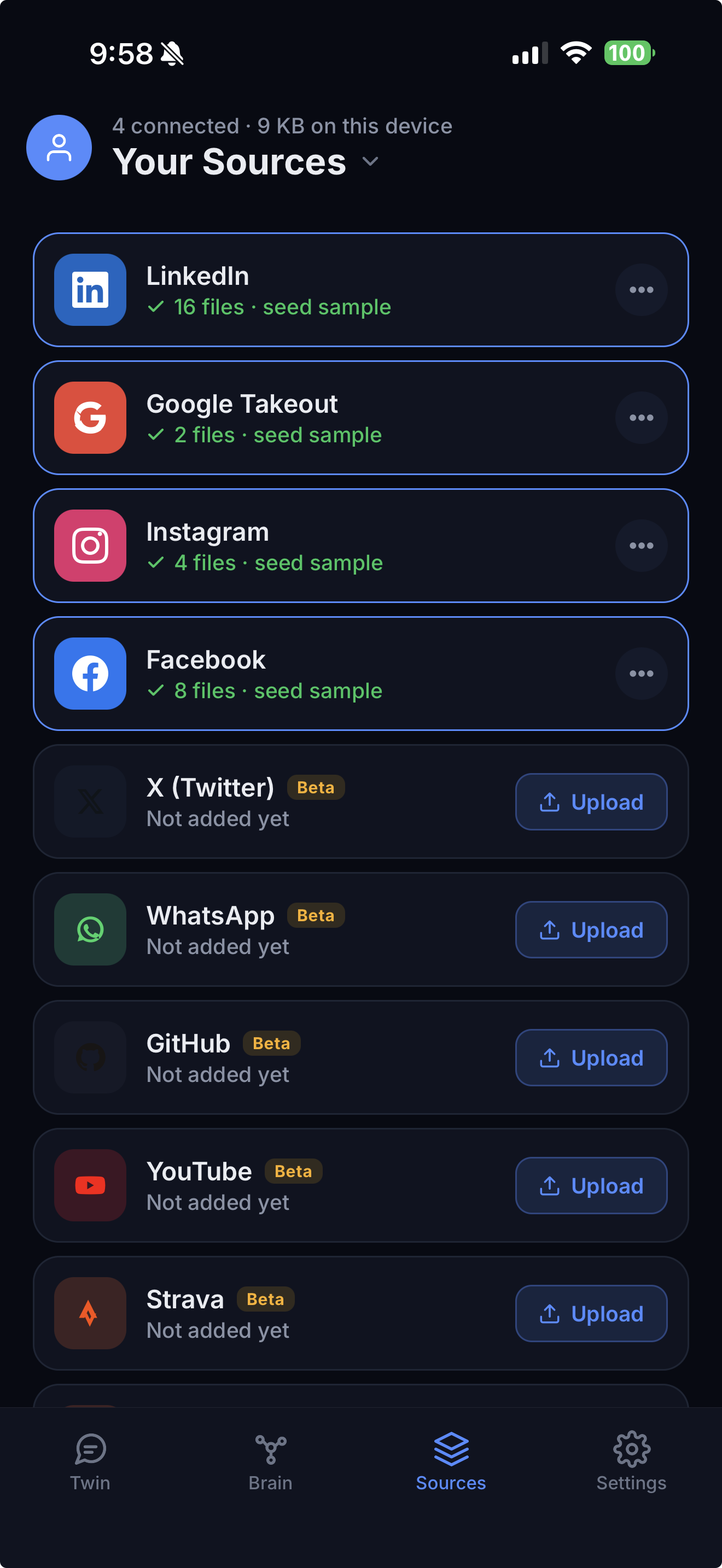
Built on-device
Import your LinkedIn, Facebook, Instagram and Google exports on the phone — the full transform runs locally, and the brain lives in your pocket.
The graph in your hand
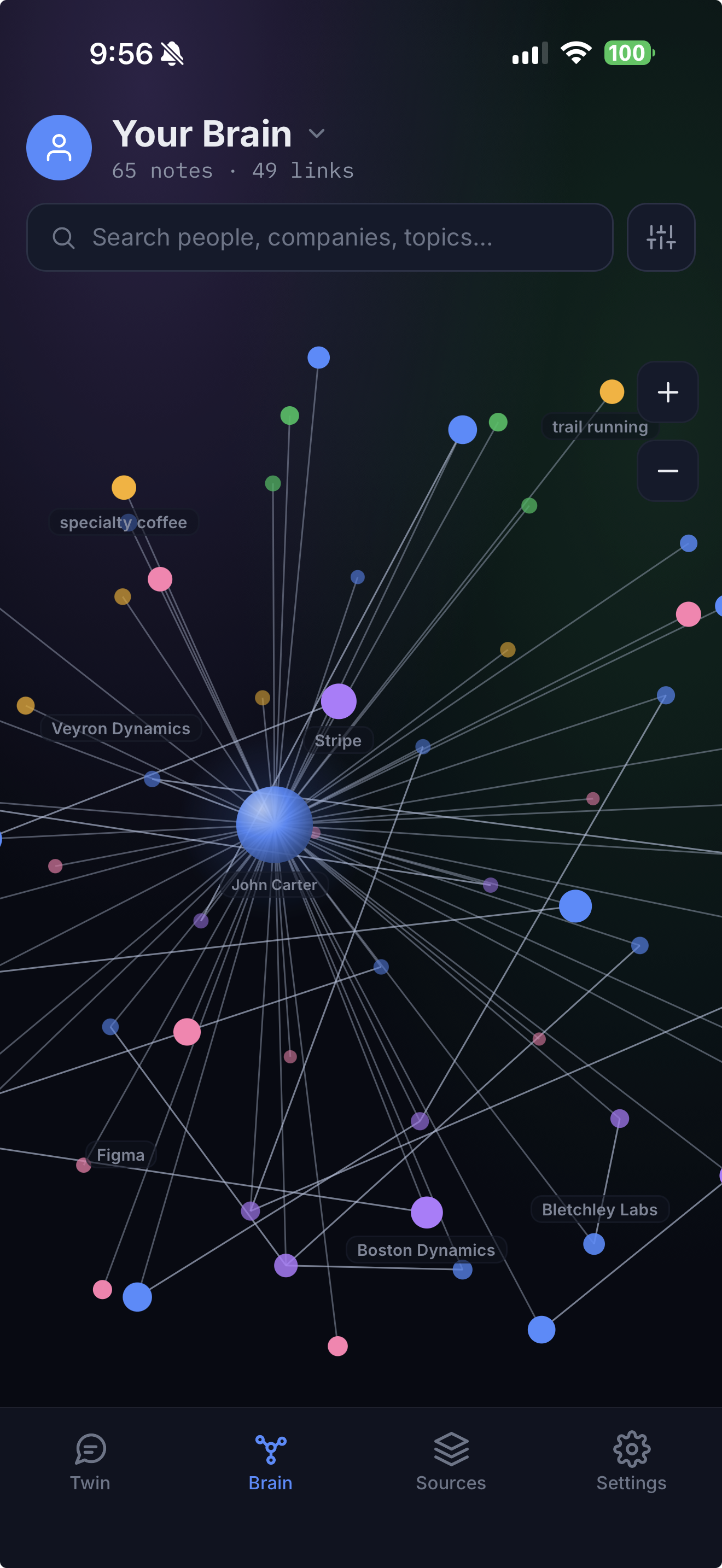
A native, buttery-smooth graph of everyone you know and everything they connect to — search it, filter it, tap into any note.
Private by architecture
No account, no backend, zero telemetry. On-device AI on iPhone; on Android bring your own key — either way your data never leaves the device.
Live on the App Store and Google Play — free, no account. On-device AI needs a recent iPhone; on Android you bring your own model key. Either way the brain is built on the phone and stays there.
The problem
Every AI brain ships empty.
Models are a commodity now — everyone runs the same ones and they get cheaper every quarter. What is scarce is context. Every assistant you open starts knowing nothing about you: not who you know, not where you have been, not what you decided or why. That context exists. It is sitting in export archives no human reads and no agent can use.
data/
├── linkedin/
│   ├── Connections.csv        2,847 rows, no context
│   ├── Positions.csv
│   └── messages.csv           never parsed
├── facebook-export.zip        friends.json, 14 MB
├── instagram-export.zip       followers_1.json
└── takeout-20260514.zip       contacts, maps, 2.1 GB

✕ four formats, zero links, same person 3×
vault/my-brain/
├── Home.md                    entry point
├── 00-me/profile.md
├── 10-people/
│   └── Sam-Patel.md           1 note · 3 sources
├── 15-organizations/
├── 40-career/timeline.md
├── 85-places/
└── 90-synthesis/
    └── network-map.md         who you actually know

✓ one graph — typed, linked, deduplicated
Nobody is short of intelligence any more. Everybody is short of context — and the context is already sitting on a disk somewhere, in a format built to be unreadable.
The supply
The law already pried your data loose. Nobody uses it.
Every platform that matters is legally compelled to hand you a machine-readable copy of your own data, on request, for free. The hard part was never getting it out. The hard part is that what comes back is unusable — so it gets downloaded once and never opened again.
Guaranteed by statute
GDPR Article 20 and the EU Digital Markets Act require a structured, commonly used, machine-readable export. Not a favour, not an API deal that can be revoked — an obligation, enforced with nine-figure fines.
It gets better on a schedule we don't pay for
The DMA moves gatekeepers toward continuous, real-time portability. The pipe we depend on is being widened by regulators, not by our roadmap.
Consent is built in
It's your export, requested by you, processed on your machine. No scraping, no terms to violate, no access anyone can switch off.
The most defended data in the world was forced into an open, consented channel — and it lands as a zip nobody can read. That gap is the whole company.
How it works
One prompt. About a minute. No AI tokens spent.
The transform is deterministic, not generative — the same archive produces the same graph every time, and you can read the code that decides. AI is spent only on the residual: files nothing recognises.
- 01
Detect
Tell your agent to build your brain from a folder of exports. The skill catalogs every file it recognizes — CSV, JSON, Takeout — locally.
- 02
Resolve
The same person on three platforms becomes one identity. Names are normalized and matched — precision-first: a wrong merge is worse than a miss.
- 03
Build
Every entity becomes a typed Markdown note with clean frontmatter and resolved wikilinks. No AI calls, no cost.
- 04
Open
Open the vault in Obsidian, or point Claude Code at it and give it a goal.
Export formats drift constantly — across platforms, versions and regions — and a hardcoded converter breaks the day they do. This one profiles your actual archive, rewrites its own mappings to fit it, and writes a coverage report proving what it did and didn't use. How self-adapting works →
Identity resolution · the hard part
One human, three messy sources, no PII stored.
This is the part that isn't a weekend project. Sam Patel is a LinkedIn connection, a Facebook friend and a Google contact — three orphan notes in every other tool. Merging them into one identity, on your machine, without ever writing an email address or a phone number to disk, is the engineering that makes the rest possible.
Said precisely: matching is on the normalized name, and it is precision-biased on purpose — a wrong merge is worse than a miss. Variant spellings and initials ("Sam P.") stay separate rather than quietly fusing two people into one. Sharper matching on secondary signals is roadmap, not shipped. Email addresses are never used as names — they are stripped at parse time.
Custody, not promises
The risk isn’t gathering it. The risk is where it already sits.
Your history is already spread across a dozen services you cannot search, cannot leave and do not control. Gathering it here does not create the exposure — it ends it. The core transform makes no network calls at all, so the question stops being "where does the vendor say this goes?" and becomes "which machine is it on?"
Physical isolation
Data that is generated, processed and stored on local hardware with no connection cannot be intercepted in transit, because there is no transit. The whole pipeline runs on an air-gapped box.
Jurisdictional certainty
Residency rules govern where data may travel. Offline processing collapses the boundary from a country to a room — you can point at the machine your institutional memory lives on.
No dependency to outlive
Local processing keeps working when a provider is down, acquired, repriced or served with an order in another country. Plain Markdown on your disk has no expiry date.
Stated precisely, because this is a category where vagueness is worthless: the architecture is air-gap-capable today and you can verify that in the source. The enterprise wrapper around it — SSO, audit trail, private deployment, compliance pack — is on the roadmap, not shipped. We'll say so until it is.
Agent-ready
Not notes. Structured data your agent can reason over.
Typed frontmatter, resolved wikilinks, real Obsidian Properties. An agent doesn't have to guess what a note means — and when it answers, it cites the notes it stood on. Receipts, not vibes.
Real Obsidian Properties
Typed frontmatter on every note — person, organization, place — with ISO dates and enums, not freeform text.
Wikilinks are edges
Every [[link]] resolves to a real note. Your agent traverses the graph the same way you click through it.
Layered vault
00-me → 10-people → 40-career → 85-places → 90-synthesis. Stable paths an agent (or a script) can rely on. Place notes carry kind, rating, city and country; people and orgs get a lat/lng from the offline geocoder.
In-vault CLAUDE.md
The vault ships with instructions for Claude Code and an Agent Skill — your agent knows how to use it on first open.
Every analyzed brain grades itself: _HEALTH.md lists the merges it made, the names it refused to merge, and what is still thin — so you know where the graph is strong before an agent leans on it.
Where your brain lives
Obsidian + Claude Code by default. GBrain when you want it.
Obsidian vault
DefaultA real graph with native Properties. No plugins required — open Home.md and it works.
Claude Code & OpenAI Codex
DefaultShips as an Agent Skill plus an in-vault CLAUDE.md. Your agent knows the schema on first open.
GBrain
OptionalAsk for the GBrain format and a company's exports become a Company Brain in the open GBrain format.
We don't reimplement search, synthesis, or serving — Obsidian, Claude, Codex, and GBrain do that. We do the part none of them do: turn export archives into a clean, identity-resolved brain.
Local-first · enforced in code
Privacy isn't a promise. It's the code.
Zero network calls in the core — your exports never leave your machine. The rules are enforced in source you can read.
PII never written
Third-party emails and phone numbers are stripped at parse time — they never reach disk.
Bodies never read
Message content is never parsed. Only a frequency and recency signal survives.
Sensitive files quarantined
Logins, receipts, and message archives are skipped by a hard-coded quarantine list.
Owner mode
Building your own brain? Owner mode keeps everything — still 100% local.
This is the privacy policy, enforced in code. → View on GitHub
The Agent Skill · Claude Code & OpenAI Codex
The engine itself — install the skill, then just ask.
The product that powers everything: the open-source engine, packaged as a cross-model Agent Skill. Install it once in Claude Code or OpenAI Codex and your agent knows how to build, update and reason over second brains — locally, with zero network calls. No app required; your AI is the interface.
One skill, two runtimes
One shared engine, thin Claude Code and Codex packagings (the Agent Skills open standard). Prefer a terminal? It also runs as a plain CLI.
Self-adapting
It profiles any export, writes its own mapping rules when formats drift, and rescues files it doesn't recognize — nothing is lost.
Yours forever
MIT-licensed, dependency-free Python, zero network calls in the core. Read the code, fork it, add your own source adapters.
The same skill builds your brain in Studio, which installs it for you — see Get started. The mobile app carries its own on-device port of the engine. Browse the source on GitHub.
Get started
Three steps. No terminal.
- 01
Download the app
Second Brain Studio for Mac, Windows or Linux. Free.
- 02
Let Setup do the rest
Pick the AI you already pay for — Claude, ChatGPT, or an API key. Setup installs it, signs you in and adds the three agents. Python comes built in.
- 03
Add your data
Upload your LinkedIn, Google, Instagram… exports and press Build. Then ask it anything — or give it a job.
Already use Claude Code or Codex? Ask it: “Install Second Brain Link by following secondbrainlink.com/install.md” — other ways to install.
What you can do
Don't search your data. Give your brain a goal.
Honest limit: your export is a snapshot — sharp on history, blind to this week. Re-export and press Update — the brain is refreshed in place, your edits are kept; hosted, scheduled sync lands with Cloud.
Agents · the brain that acts
Then put it to work.
A brain you can only ask is a filing cabinet. These agents run the job — the hunt, the raise, the trip — from what your brain already knows, and hand you every decision.
Jobs Agent
v1.1 · shippedFinds roles that fit your criteria, tailors a CV to each from your own facts, and fills the form.
never submits without you · never touches LinkedInFundraising Agent
v0.2 · previewScreens funds and programs through your filters, verifies each on its own site, and drafts every application and email.
never sendsTravel Agent
v0.1 · previewTurns places you saved into trip ideas, draws the itinerary on the Map, and shops flights and stays in your browser.
never books- Network Revival Agent — a drafted message for each tie going quiet planned
- Briefing Agent — a dossier for every meeting today planned
- Follow-Up Agent — silences and promised intros, surfaced planned
Nothing is sent, submitted or booked without you.
Gates are code, not policy. Everything an agent learns is yours to see, edit or remove.Honest limit: agents run locally in Studio through your own Claude Code — not the hosted Studio. The brain they read is a snapshot.
Memory · agents that remember
Tell it once. Every run after starts smarter.
The brain chat and every agent keep a memory inside your brain — what you told them, what happened, what they worked out — and read it before they act.
- 01
Recall
Before it answers or acts, the chat or agent reads what it already knows — only the memories that fit this task.
- 02
Act
It does the work and says which memories changed what it did, so you can check it.
- 03
Learn
Your corrections, real outcomes and its own lessons are saved on the spot — no forms, no approval step.
- 04
Compound
A repeat strengthens a memory instead of duplicating it. The next run starts from everything before it.
Works by itself
Nothing to approve and nothing to file. Memories are saved and used as they happen.
Inferences are flagged
What an agent worked out on its own is marked inferred, so you can see it apart from what you said. If you would rather approve those first, turn that on.
Yours to edit
Plain Markdown in your brain. Edit, retire or forget any memory in Studio's Memory manager, or in Obsidian.
Never leaves your machine
No model training, no cloud copy, no embeddings. Memory is text files you own.
A developer preview: it improves as fast as real outcomes arrive — we don't claim a rate. How memory works →
Roadmap
A weekend script doesn't have a roadmap. This does.
LinkedIn → vault
Full local transform, Obsidian-native.
Multi-source
Facebook, Instagram, Google — one identity-resolved graph.
Cross-model + company
Claude + Codex, per-entity brains, GBrain emitter, JSON mappings.
27 sources
Amazon, X, WhatsApp, GitHub, YouTube, Strava, Reddit, Spotify, TikTok + 14 company sources (incl. your docs repo and Google Drive); offline geocoding and the Studio Map view; desktop app for Mac, Windows and Linux with auto-update; a newer export updates the brain in place.
Sharper identity
Matching on secondary signals, still precision-first. Today it is name-only — and says so.
Always-fresh sync
Hosted, scheduled re-import so the brain never goes stale — the paid layer. The in-place update on your own computer already ships.
Anatomy & activation
Cellular graph anatomy + spreading-activation retrieval, animated on real numbers. 25k-note vaults render fully.
The brain that acts
First slice shipped: the Jobs, Fundraising and Travel agents + Studio's Agents tab. Next: the Harness — procedures, runs, briefings — and grounded search from your brain's context.
Local OSS core free forever. Done-for-you company onboarding and hosted sync are how it becomes a company.
Built in the open
Open source, by design.
MIT-licensed. This is why an incumbent can't build it: their business is locking your data in — ours is handing it back, working.
MIT-licensed and open from day one. Read the source, file an issue, or help shape v2 — the agents.
★ Star on GitHubYour brain shouldn't start empty.
The second brain that starts full, not empty — then give it a job →
MIT · local-first · Obsidian + Claude Code + OpenAI Codex · emits to GBrain · ★ star it on GitHub · for companies →